Craniosacral Therapy for Pregnancy, Newborns and Babies
Craniosacral Therapy for Pregnancy, Newborns and Babies
Relational Craniosacral Therapy for Mother & Baby
Pregnancy and birth are significant physical and emotional transitions for both mother and baby.
My approach to Craniosacral Therapy for pregnancy, newborns and babies is gentle and relational. I pay attention to the baby’s body and communication, the mother’s experience and the developing relationship between them.
You don’t need to wait until feeding is difficult, your baby is unsettled or you are exhausted.
Plan your care during pregnancy and make birth recovery part of preparing for your baby.
Craniosacral Therapy During Pregnancy
Pregnancy is often about preparing for birth and baby — but how are you?
Gentle Craniosacral Therapy offers time to slow down, connect with your changing body and prepare for motherhood and your relationship with your baby.
It is also an opportunity to plan a mother-and-baby appointment after birth, rather than waiting until something becomes difficult.

Craniosacral Therapy for Newborns & Babies
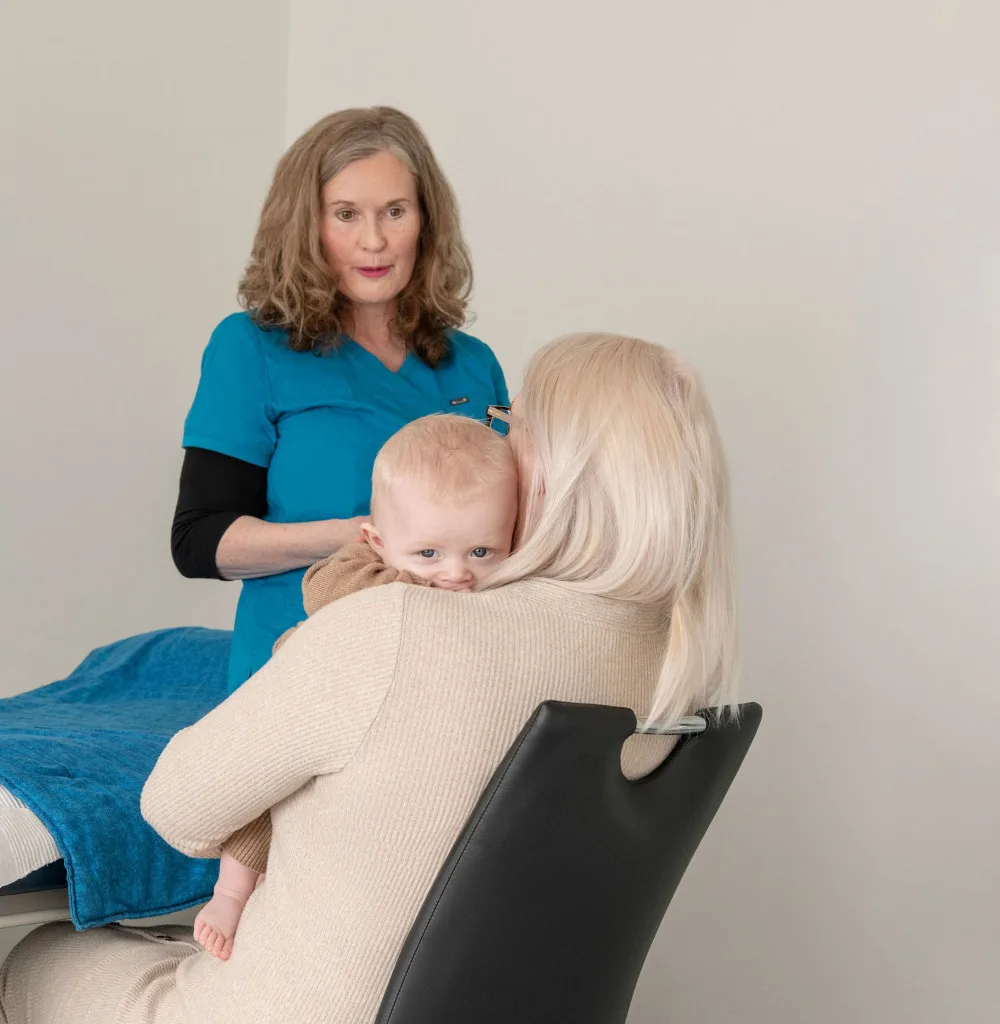
Babies communicate through their whole bodies — through movement, facial expression, turning, stiffening, softening and crying. Sessions are gentle, baby-led and flexible. Your baby can feed, sleep, move or be held throughout.
Parents often come with concerns around:
breastfeeding, latch or tongue-tie follow-up
jaw, neck or body tension
preference for turning the head one way or preferring one side breastfeeding
high-pitched or inconsolable crying
difficulty settling/getting consoled
wind, reflux or colic-like symptoms
arching or stiffening
long, fast or assisted births
planned and emergency C-section birth are both impactful of the newborn
The baby’s pace matters.
The mother’s experience matters.
The relationship matters.
What Happens in a Mother & Baby Session?
We begin by talking about pregnancy, birth, feeding and what you have noticed since bringing your baby home. I am interested in your concerns, but also in getting to know your baby as a unique little person.
Your baby remains fully clothed and may lie on a soft treatment surface, rest on your lap or be held in your arms. I use very gentle touch, often around the feet, pelvis, spine, ribs, neck, head, jaw or inside the mouth when appropriate and with your consent.
There is no fixed sequence. Your baby sets the pace, and the session changes according to what they need. They can feed, sleep, cry, be held or have a nappy change. The session is guided by our curiosity about what your baby may be communicating.
Frequently Asked Questions About
Craniosacral Therapy for Babies
Is Craniosacral Therapy safe for newborn babies—and how soon can my baby have a treatment?
Craniosacral therapy is a very gentle, non-invasive therapy. The touch I use with a newborn is light, respectful and always guided by the baby’s responses.
If your baby is having difficulty feeding or latching, an appointment can be arranged soon after birth. Early support may help us understand whether tension through the mouth, jaw, neck or body is making feeding more difficult.
If feeding is going well and you have no immediate concerns, it can be lovely to remain in your newborn bubble for the first couple of weeks. This gives you time to rest, accommodate the hormonal changes and get to know your baby and yourselves as a new family.
Craniosacral therapy is complementary care and does not replace assessment by your GP, paediatrician, public health nurse or lactation consultant when medical or feeding concerns are present.
What can Craniosacral Therapy help with in babies?
CST supports emotional and physical health from the inside out through the craniosacral system.
Parents bring their babies for many different reasons. Mostly I hear mums say…’something is just not ok with my baby ‘ I listen to their natural instincts and support them to slow down and tease out the details. Sometimes there is an OBVIOUS concern; at other times, a parent simply senses that their baby is uncomfortable or finding it difficult to settle.
Parents commonly are referred on by professionals or friends and contact me about:
Feeding or latching difficulties and challenges
C-section both planned and unplanned
Tension or stiffness through the neck and body
Difficulty turning the head comfortably in both directions/preferring one side
Unexplained or prolonged crying
Colic, wind, reflux or digestive discomfort
Difficulty settling or sleeping
Recovery following a long, fast or medically assisted birth
Caesarean, forceps or ventouse birth
Support before or after a tongue-tie release/conflicting diagnoses for tongue tie
A baby who appears startled, tense or difficult to comfort
Craniosacral therapy does not treat a medical diagnosis. It offers gentle support for your baby’s comfort, movement and ability to settle while working alongside any appropriate medical, feeding or developmental care.
How do I know if my baby might benefit from Craniosacral Therapy?
Your baby does not need to have an obvious symptom or a difficult birth to receive Craniosacral Therapy. Every baby has made a remarkable journey through pregnancy and birth, whether born vaginally or by caesarean.
During a session, I listen through gentle touch to how your baby’s body is holding that experience. We notice where movement feels easy and where there may still be tightness, bracing or a sense of being unsettled.
We do not force the body to change. We give your baby time, support and a safe relational space in which held tension may gradually soften and reorganise.
We also listen to what happened around the baby. Was there fear, urgency or an unexpected intervention? Was the mother frightened, overwhelmed or separated from her baby? These experiences can matter, and they are approached gently—without assuming that every difficulty is caused by the birth.
Can Cranioscral Therapy help after a difficult or traumatic birth?
A difficult birth can affect both mother and baby. The experience may have included a long labour, a very fast birth, induction, forceps, ventouse, an emergency caesarean, medical urgency or separation after birth.
A baby may appear tense, startled, unsettled or uncomfortable afterwards. A mother may also be trying to make sense of what happened while recovering physically, managing hormonal changes and caring for her newborn.
Cranioscral Therapy offers a gentle space in which we can slow everything down. I follow your baby’s responses and support their body to soften where it is ready. There is no need to make the baby relive the birth or to decide in advance what the experience meant for them.
Where appropriate, I may also suggest support for the mother. Sometimes helping both mother and baby settle creates more ease in feeding, holding, bonding and being together.
Can Cranioscral Therapy help with breastfeeding and latching difficulties?
Breast feeding is a connected nurturing relational experience and we work together to enhance the biological instinct of mother and baby. We also release any tightness in the mussels around the neck, jaw, shoulders and breathing, so suck and latch can be coordinated in a relaxed way and tongue and jaw movement are encouraged to function in a natural rhythm—not only the mouth and tongue. Comfortable feeding also depends on movement through the jaw, neck, shoulders, ribs and diaphragm, as well as the baby’s ability to coordinate sucking, swallowing and breathing.
During a session, I gently listen and treat areas of tension that may be making it harder for your baby to turn, open their mouth, stay latched or feed comfortably on both sides.
Your baby can be fed during the treatment. This lets us observe what happens in real time and make the session relevant to the difficulty you are experiencing.
Cranioscral Therapy complements, rather than replaces, skilled breastfeeding support. Concerns about latch, milk transfer, nipple pain or weight gain should also be assessed by an IBCLC, lactation consultant, public health nurse or appropriate healthcare professional.
Can Cranioscral Therapy help a baby with tongue-tie?
Cranioscral Therapy cannot diagnose or remove a tongue-tie. However, it may support a baby who has tension through the mouth, jaw, neck or body alongside a suspected or confirmed tongue-tie.
Sometimes the visible frenulum is only one part of the feeding picture. It is also important to consider how the tongue is functioning, how the baby coordinates feeding and whether there are wider patterns of tension.
I work collaboratively with lactation consultants, feeding specialists and the medical professionals involved in your baby’s care.
Should my baby have Cranioscral Therapy before or after a tongue-tie release?
Cranioscral Therapy can be offered both before and after a tongue-tie release.
Before the procedure, gentle bodywork may help ease some of the surrounding tension and give a clearer picture of what remains difficult. After the release, it may support the baby as they adapt to new movement through the tongue, mouth and jaw.
A release is not always the whole answer to a feeding difficulty. Ongoing feeding support and appropriate aftercare remain important, and decisions about a tongue-tie procedure should be made with a suitably qualified medical or feeding professional.
Can Cranioscral Therapy help with reflux, wind or colic?
Some babies strongly prefer looking or feeding towards one side. You may notice that your baby finds one breast easier, resists turning their head or always sleeps with their head facing in the same direction.
I gently explore movement through the head, neck, shoulders, spine and pelvis, always staying within your baby’s comfort. We do not stretch or force the head into position.
A persistent head tilt, restricted movement or concern about head shape should also be assessed by your GP, public health nurse, paediatric physiotherapist or other appropriate healthcare professional.
Can Cranioscral Therapy help an unsettled baby sleep?
Cranioscral Therapy cannot promise that a baby will sleep for longer—and frequent waking can be entirely normal in infancy.
However, when a baby is holding a lot of physical tension or appears to remain on high alert, gentle treatment may help them feel more comfortable and supported in settling.
Some babies sleep during or after a treatment. Others remain quietly alert, feed or need time to process the experience. We follow your baby rather than expecting a particular response.
What happens during a Cranioscral Therapy treatment for a baby?
We begin by talking about pregnancy, birth, feeding and what you have noticed since bringing your baby home. I am interested in your concerns, but also in getting to know your baby as a unique little person.
Your baby remains fully clothed and may lie on a soft treatment surface, rest on your lap or be held in your arms. I use very gentle touch, often around the feet, pelvis, spine, ribs, neck, head, jaw or inside the mouth when appropriate and with your consent.
There is no fixed sequence. Your baby sets the pace, and the session changes according to what they need.
Does my baby have to stay still during treatment?
No. Babies do not need to stay still or behave in a particular way.
Your baby can move, stretch, feed, sleep, look around or be held. I adapt my position and my contact to meet your baby where they are.
Movement is often part of how babies communicate and reorganise. The session is shaped around your baby, rather than asking your baby to fit around the treatment.
Can I hold, feed or change my baby during the treatment?
Yes. You are an important part of the session, and your baby can remain close to you throughout.
You can hold, feed, comfort or change your baby whenever needed. Treatment can continue while your baby feeds or rests in your arms if that feels right for both of you.
There is no need to delay a feed or persist with treatment when your baby is asking for something else. Responding to their needs is part of the work.
Does my baby need to be undressed?
Usually, no. Your baby can remain comfortably clothed, and I can treat through light clothing. Sometimes, we take some layers off if the baby seems hot or uncomfortable with enclosed baby grows or bibs.
I may sometimes suggest loosening or removing a layer if clothing is restrictive, but this is discussed with you first. Your baby’s warmth, comfort and sense of safety come before everything else.
What if my baby cries during treatment?
Crying is one of your baby’s earliest forms of communication. It tells us about hunger, tiredness, discomfort, the need for closeness, or when something simply feels too much.
Sometimes a different kind of crying can emerge during a session—what I describe as memory crying. This may feel like an unexpressed cry connected with an earlier experience, including birth.
Birth is an active process for a baby. Babies have natural impulses to move, turn, push and progress through the birth process. During a long, difficult or assisted birth, or when labour changes course, these natural movements may have been interrupted or unable to complete in the way the baby’s body was expecting.
In craniosacral therapy, we may notice movements, sounds or crying arising alongside expressions of stuckness through the whole body, often accompanied by grunting, pushing or frustration. Rather than assuming exactly what the crying means, I stay curious and follow your baby’s cues. Through gentle guiding touch, I support the movements your baby’s body appears to be seeking—sometimes allowing them to explore now what they may have struggled to complete during birth.
For parents, hearing your baby cry can be incredibly difficult—and there is a biological reason for this. Parents are wired to notice and respond to their baby’s cries. The sound can immediately activate a powerful urge to pick them up, soothe them and make the crying stop. This responsiveness is an important part of bonding and your baby’s survival.
So when crying arises during a session, I support the parent as much as the baby. Rather than asking you to ignore your instinct, we listen together: What does my baby need from me right now? Sometimes they need feeding, holding or a change of position. At other times, they may need you to remain close and confident while they express something that cannot be immediately soothed away.
I may invite you to slow your breathing, bring your awareness to your heart and notice what is happening inside you. This can help you remain connected with your baby without becoming overwhelmed by their distress. Your baby can feel that you are there—present, responsive and trusting them.
This is why accompanying the baby through crying is so important. We never leave a baby alone to cry or deliberately encourage distress. We stay close, respond and allow whatever is arising to happen within the safety of relationship.
As parents become more able to stay present with their baby’s distress, the baby can have a different relational experience: I can have this feeling. I can express what I need to express, and I am not alone.
The aim is never to make a baby cry. It is to listen to their communication, follow their natural impulses and ensure that whatever arises, your baby is accompanied through it.
How many Cranioscral Therapy sessions will my baby need?
Every baby is different, and I let your baby’s response guide whether further sessions may be helpful. Sometimes changes can be noticed during the very first session, particularly when breastfeeding or latch difficulties are involved. A mother may feel her baby’s suck or latch change while feeding. Parents may also notice that their baby seems stretched out, lighter and more relaxed, turns more easily, lies down more comfortably, is happier during nappy changes, sits more comfortably in the car seat or simply seems more at ease in their body.
These outward changes can reflect a deeper shift in patterns of tension held through the baby’s body. Following a difficult or stressful pregnancy or birth, baby may have adapted around compression, restriction or interrupted movements. Craniosacral therapy gently supports your baby’s natural movements and orientation towards health, allowing their body an opportunity to find greater ease and a different way of organising itself.
This process end when the session finishes as the body is resetting itself towards. Changes may continue to settle and integrate over the following days, which is why I like to give your baby’s body time before the next session.
When a second session is indicated, I generally recommend it within about 10 days of the first appointment, while allowing space around routine vaccinations so that we can more clearly follow your baby’s responses. The early weeks—from around 2 to 7 weeks old—can therefore be a lovely time to begin, particularly when there are concerns about feeding, latch, comfort or recovery following pregnancy and birth. If feeding is difficult, however, there is no need to wait.
Some babies show enough change after one or two sessions, while others benefit from further support, particularly where feeding has been difficult or the pregnancy or birth was more complicated. I don’t recommend a fixed number of treatments in advance. We follow the changes, give them time to integrate, and trust the wisdom of your baby’s body to help guide what comes next.
What might I notice after my baby’s craniosacral treatment?
Every response is individual, so I encourage you to observe your baby without feeling that a particular change must happen.
Some babies are deeply relaxed and sleep after a session. Others may feed, pass wind or have a bowel movement. You may notice easier movement, a softer or lighter body or a change in how your baby settles or feeds.
Some babies need quiet time afterwards and may be temporarily more wakeful or unsettled.
If your baby develops new, persistent or worrying symptoms, seek medical advice rather than assuming that these are an expected response to treatment.
Are there times when my baby should not receive Cranioscral Therapy?
If your baby has a fever, acute illness, recent injury, breathing difficulty, repeated forceful vomiting, unusual drowsiness or another unexplained symptom, medical assessment comes first. I recommend the first treatment from 2 weeks to 4 weeks, so we can work with birth imprints before vaccines to optimise the impact on their immune system.
Cranioscral Therapy is complementary support. It should never delay or replace necessary medical care.
Cranioscral Therapists cannot diagnose or remove a tongue-tie. However, it may support a baby who has tension through the mouth, jaw, neck or body alongside a suspected or confirmed tongue-tie.
Sometimes the visible frenulum is only one part of the feeding picture. It is also important to consider how the tongue is functioning, how the baby coordinates feeding and whether there are wider patterns of tension.
I work collaboratively with lactation consultants, feeding specialists and the medical professionals involved in your baby’s care.
Is CST covered by private health insurers?
Some private health insurance plans may provide reimbursement for complementary therapies. Coverage varies according to your individual policy and the professional qualifications recognised by your insurer. Please check directly with your insurer before your appointment.
Does a Therapist’s Training Make a Difference?
Training and experience matter because they shape how a therapist understands the body, listens and responds to what emerges. I have trained extensively in both Upledger CranioSacral Therapy and Biodynamic Craniosacral Therapy, allowing me to draw from both approaches rather than being limited to one way of working.
But technique is only part of therapy. Research across psychotherapy consistently shows that the quality of the therapeutic relationship—the sense of trust, safety, connection and being understood—is associated with better outcomes, regardless of the particular therapeutic approach. For me, this relational connection is at the heart of craniosacral therapy: bringing my training and experience while listening carefully to you, or your baby, and allowing the individual body to guide the session.